IT Lifecycle (Overall) Why Every Business Needs a Full IT Lifecycle Strategy — Not Just a Procurement Plan

Introduction

Most businesses think about IT equipment in isolated moments: buying it, fixing it when it breaks, replacing it when it’s outdated. What’s often missing is the bigger picture — that every device an organization uses moves through a connected IT lifecycle management process, and how well each stage is handled directly affects cost, security, and compliance. Treating these stages as separate, disconnected events is where most organizations lose visibility, money, and control.

The Six Stages of the IT Lifecycle

  1. Procurement The starting point — sourcing the right hardware for the right need, at the right cost. Procurement decisions made without lifecycle thinking often create downstream problems: hardware that’s mismatched to actual use cases, or purchasing patterns that make future upgrades harder than they need to be.
  2. Deployment Getting equipment configured, installed, and rolled out across teams and locations. Poor deployment planning is a common source of downtime and support overhead in the months that follow, especially across multi-site organizations.
  3. Security IT assets carry data and access throughout their working life — not just at the point of disposal. Ongoing IT asset lifecycle security, from access controls to timely patching, needs to be built into how equipment is used day to day, not bolted on afterward.
  4. Rental For many organizations, not every hardware need justifies ownership. Rental fills gaps — scaling teams, short-term projects, or hybrid workforces — without the long-term cost and depreciation burden of outright purchase.
  5. Disposal When equipment reaches end-of-life, how it’s retired matters as much as how it was procured. Improper disposal creates both environmental liability under e-waste regulations and data security risk from unwiped devices left in circulation.
  6. Solar An increasingly relevant addition to the lifecycle conversation — as businesses look at their broader infrastructure footprint, sustainable power solutions like solar lighting are becoming part of the same conversation as responsible IT management.

Why Managing These in Isolation Creates Risk

When procurement, deployment, security, rental, and disposal are handled by different vendors — or not handled with any coordination at all — gaps appear. A device procured without lifecycle planning becomes harder to track for security purposes. A device retired without certified data destruction becomes a compliance liability under regulations like India’s DPDPA 2023 and the E-Waste (Management) Rules, 2022. A rental agreement without a clear end-of-lease data protocol creates exposure neither the business nor the provider accounted for.

The Case for a Single Lifecycle Partner

Organizations that manage end-to-end IT management under one coordinated approach typically see better cost visibility, with no fragmented vendor relationships or duplicated overhead; a stronger compliance posture, with consistent data handling standards from deployment through disposal; and less operational friction, with one point of accountability across the equipment’s working life instead of five.

How CISIPL Approaches the Full IT Lifecycle

This is the core of how CISIPL works with clients — not as a single-service vendor, but as a partner across the entire IT lifecycle strategy: procurement, deployment, security, rental, disposal, and increasingly, solar-powered infrastructure. The goal isn’t just supplying technology — it’s managing it responsibly from the day it enters your business to the day it leaves.

Ready to manage your IT lifecycle under one partner instead of five vendors?

Talk to CISIPL

Rental Rent vs. Buy: Why More Indian Enterprises Are Choosing IT Equipment Rental

Introduction

For years, owning IT hardware outright was the default. That’s changing fast. With hybrid work now standard, technology refresh cycles shrinking, and CFOs under pressure to keep balance sheets light, a growing number of Indian enterprises are treating IT equipment rental as something to use — not something to own. What used to be a stopgap for short-term needs has become a deliberate financial and operational strategy for companies of every size.

Why Rental Is Gaining Ground

  1. Converts CapEx to OpEx Instead of a large upfront hardware investment, rental converts IT spend into predictable monthly costs — easier to budget, easier to scale, and easier to justify without tying up capital that could go toward core business priorities. For finance teams, this shift alone often makes IT hardware leasing an easier conversation than a large one-time purchase order.
  2. Always-Current Technology Hardware bought today can be functionally outdated within three years. Rental models let organizations refresh equipment on a cycle that matches actual technology needs, rather than being stuck with depreciating, underperforming assets that slow teams down.
  3. Faster Deployment Whether onboarding a new hire, scaling for a project, or opening a new location, rental providers can deploy equipment in days — far faster than the internal procurement, sourcing, and approval cycles that outright purchasing typically requires.
  4. Reduced Maintenance Burden With rental, the provider typically owns the maintenance and support responsibility — meaning fewer surprises from hardware failures and less internal IT bandwidth spent troubleshooting aging equipment. This is especially valuable for enterprise IT rental arrangements spanning multiple offices or locations.
  5. Built-In Flexibility Project-based teams, seasonal scaling, event staffing, and hybrid workforces all create unpredictable hardware demand. Rental lets organizations scale equipment up or down without being locked into ownership, avoiding the sunk cost of unused hardware sitting idle.

Who Benefits Most from IT Rental

  • Startups and scaling companies conserving capital during growth phases
  • Enterprises expanding into new cities that need infrastructure fast, without waiting on procurement cycles
  • Organizations with hybrid or distributed workforces needing to equip employees across multiple locations
  • Companies running short-term projects, training programs, or events with defined, time-bound hardware needs

What to Consider Before Choosing a Rental Partner

  • Data security at end-of-lease— ask how devices are wiped and sanitized before reuse or return; this matters especially under India’s DPDPA 2023 obligations around data protection
  • Support and turnaround time — how quickly can the provider replace or repair faulty equipment when something breaks mid-project
  • Range of hardware available — from laptops and desktops to servers and networking equipment, depending on your operational needs

How CISIPL Approaches IT Rental

Rental is one piece of the full IT lifecycle CISIPL manages for clients — sourced, deployed, supported, and eventually retired or refreshed, all under one provider. That means hardware rented through CISIPL is backed by the same secure data-handling and compliance standards we apply across procurement, deployment, and disposal, so flexibility never comes at the cost of security.

Considering IT rental for your next hiring wave, project, or office expansion?

CISIPL about flexible IT rental

Why More Indian Businesses Are Switching to Solar Street Lighting

Introduction

Across India’s industrial parks, campuses, and highways, a quiet shift is underway: businesses are replacing conventional street lighting with solar street lighting. It’s not just an environmental gesture — for facilities managing dozens or hundreds of light poles, solar has become one of the more straightforward ways to cut recurring costs while improving reliability. As energy prices climb and sustainability commitments move from optional to expected, more organizations are asking whether their outdoor lighting infrastructure is actually working for them, or quietly draining their budget every month.

Why Solar Street Lighting Makes Business Sense

  1. Lower Operating Costs Once installed, commercial solar lighting systems run on power harvested directly from the sun — no grid electricity bill attached. For a facility running 50+ light poles for 10 hours a night, that adds up to real annual savings, with most systems paying back their installation cost within 3-5 years. Over a 10-year horizon, the total cost of ownership is typically far lower than conventional grid-powered lighting, even accounting for occasional battery replacement.
  2. Uninterrupted Operation Unlike grid-dependent lighting, solar systems keep functioning during power outages or grid instability — a meaningful advantage for industrial solar street lights deployed across warehouses, campuses, and security-sensitive zones where lighting downtime isn’t an option.
  3. Minimal Maintenance Solar street lights require far less upkeep than traditional wired systems — no trenching, no cable faults, no dependency on grid infrastructure. Most maintenance is limited to periodic panel cleaning and battery checks, which keeps long-term operational overhead low compared to conventional systems that require ongoing electrical servicing.
  4. Supports ESG and Sustainability Reporting Reduced emissions from solar lighting benefits feed directly into corporate ESG reporting and tie into any organization’s broader sustainability commitments — increasingly a factor customers, investors, and regulators look for when evaluating a business’s environmental footprint.
  5. Fast, Low-Disruption Installation Because solar street lights are self-contained units — panel, battery, and LED in one — installation avoids the trenching and cabling work that traditional grid-connected lighting requires, making it practical even for large-scale rollouts across remote or hard-to-access sites.

Where Solar Street Lighting Delivers the Most Value

  • Industrial parks and warehouses — reduce overhead lighting costs across large campuses
  • Highways and toll plazas — reliable illumination for stretches with limited or no grid access
  • Corporate and institutional campuses — consistent lighting with lower long-term maintenance load
  • Rural and semi-urban infrastructure — lighting without dependency on unreliable grid connections

What to Look for Before You Invest

Not all solar lighting systems are built the same. Before choosing a vendor or specification, it’s worth checking:

  • Battery chemistry — LiFePO4 batteries typically outlast lead-acid options significantly, reducing long-term replacement costs
  • Actual lumen output — tested performance, not just rated wattage
  • Weatherproofing rating — IP65 or higher is standard for reliable outdoor performance in India’s varied climate
  • Pole height and placement — matched to your application, since residential paths, industrial zones, and highways call for different specifications

How CISIPL Approaches Solar Deployment

As part of our full IT and infrastructure lifecycle offering, CISIPL handles solar street lighting projects end-to-end — site assessment and load calculation, system selection matched to your facility’s actual usage patterns, installation, and post-installation support. The same principle that guides our IT hardware and e-waste work applies here: build for long-term performance, not just the lowest upfront cost.

Thinking about solar lighting for your facility or campus?

Talk to CISIPL’s solar team

Does India’s E-Waste Policy Need to Evolve? A 2026 Perspective

What Is E-Waste?

E-waste refers to electronic devices and equipment that reach end-of-life — from smartphones swapped out every year to enterprise hardware retired during a technology refresh.

The Scale of the Issue Today

India’s e-waste generation has grown sharply over the past decade, and current estimates put annual volumes north of 3 million tonnes — yet the share processed through certified, authorized channels remains a fraction of that. The gap between what’s generated and what’s properly recycled is the single biggest challenge facing the country’s e-waste ecosystem.

Where the Current Policy Stands

The E-Waste (Management) Rules, 2022 strengthened Extended Producer Responsibility (EPR) obligations — requiring producers to meet defined collection and recycling targets, restricting hazardous e-waste imports, and formalizing the role of Producer Responsibility Organizations (PROs). Enforcement has visibly improved compared to the earlier 2016 framework, with environmental compensation penalties now attached to non-compliance.

Where Gaps Remain

  • Implementation is uneven — regulation on paper doesn’t always translate to enforcement on the ground
  • Informal recycling still dominates volume — awareness and infrastructure gaps push much of India’s e-waste toward unregulated channels
  • Consumer accountability is limited — there’s little direct consequence for individuals who dispose of electronics improperly

What Stronger Compliance Looks Like

For corporates, the path forward isn’t waiting on policy — it’s building internal e-waste practices that exceed the minimum regulatory bar:

  • Partnering exclusively with certified recyclers and ITAD providers
  • Maintaining documented chain of custody and certificates of destruction for every asset
  • Treating data security and environmental compliance as one process, not two

CISIPL’s Role

As enforcement tightens and EPR targets rise, working with a certified partner is quickly becoming the difference between compliant operations and real liability exposure. CISIPL helps corporates stay ahead of India’s evolving e-waste policy with certified recycling, documented compliance, and secure data destruction built into every engagement.

Stay ahead of India’s e-waste regulations.


Talk to CISIPL’s compliance team →

Protecting IT and Electrical Equipment During Monsoon Season

Introduction

Monsoon season brings essential rain — and real risk to electrical equipment. Humidity, power fluctuations, and flooding are a common cause of hardware failure across Indian offices and homes each year, and protecting equipment proactively is far cheaper than replacing it afterward.

Monsoon Hazards for Electrical Equipment

  • Moisture buildup from high humidity, causing short circuits and component damage
  • Power surges from lightning and grid fluctuations, capable of frying circuitry
  • Flooding, which can submerge and permanently disable devices

Steps to Protect Your Equipment

  1. Unplug and elevate — disconnect non-essential devices and raise essential ones (routers, computers, TVs) above potential flood level
  2. Invest in surge protectors — a strong first line of defense against voltage spikes
  3. Use waterproof coverings — especially for outdoor units like ACs and generators
  4. Check wiring and grounding — proper installation minimizes electrical accident risk
  5. Maintain equipment regularly — inspect AC units and appliances prone to moisture damage
  6. Prepare for outages — keep emergency lighting, battery banks, and backup plans ready

When Equipment Doesn’t Survive

Monsoon damage is one of the most common reasons IT hardware reaches end-of-life outside a planned refresh cycle. When that happens, resist the urge to just discard it — damaged electronics still carry data and hazardous materials that require proper handling.

That’s where certified e-waste recycling comes in: recovering valuable materials like copper and rare metals, keeping toxic components out of landfills, and — where devices held sensitive data — ensuring certified data destruction before disposal.

Equipment damaged this monsoon? Dispose of it the right way.

Talk to CISIPL about certified e-waste recycling →

How to Responsibly Recycle Electronic Waste: A Corporate Guide

What Is E-Waste?

E-waste is any electrical or electronic equipment an organization no longer uses — from laptops and servers to peripherals and networking gear. Left unmanaged, it becomes both an environmental liability (toxic materials) and a security risk (unwiped data).

India’s Push for Responsible Recycling

The Ministry of Environment, Forestry and Climate Change’s e-waste rules — updated most recently in 2022 — have pushed corporates toward formal recycling channels. Gaps in infrastructure and awareness persist, but the compliance pressure has never been higher, especially with the added weight of the Digital Personal Data Protection Act (DPDPA) 2023 governing how organizations must handle data throughout its lifecycle, including at disposal.

Five Ways to Recycle Electronic Waste Responsibly

  1. Choose a Certified ITAD and Recycling Partner Look for R2v3, NAID AAA, or e-Stewards certification. Certified partners follow strict protocols that minimize environmental and data-security risk — informal dealers don’t.
  2. Build an Internal E-Waste Recycling Plan
  • Audit retired or damaged devices across teams and locations
  • Route them to a certified recycling partner
  • Wipe all data before devices leave your premises
  • Shift more workloads to cloud storage to reduce future hardware turnover
  1. Follow Proper Disposal Steps
  • Resell still-functional devices
  • Donate to schools or nonprofits where appropriate
  • Use certified data-wiping software or physical destruction for storage media
  1. Build a Culture of Responsibility Educating employees on responsible e-waste practices reduces your organization’s ecological footprint and strengthens your reputation as a sustainability-minded business — while also surfacing cost savings through better lifecycle planning.
  2. Leverage Government Incentives India offers tax benefits and recognition for organizations actively engaged in e-waste recycling. Transparent reporting and eco-certifications can turn compliance into a competitive differentiator.

Why It Matters Beyond Compliance

Certified recycling protects more than the environment — it protects your data. Devices often carry sensitive company and customer information; improper disposal risks exposure and breach. Certified data destruction, aligned to standards like NIST 800-88, closes that gap.

Let CISIPL build your corporate e-waste recycling plan.

Get started →

From Landfills to Lungs: How E-Waste Pollution Affects Public Health

Introduction

Every discarded smartphone, laptop, or monitor that ends up in a landfill or incinerator releases a cocktail of hazardous substances — lead, mercury, cadmium, brominated flame retardants — into soil, water, and air. What starts as a disposal problem quickly becomes a public health one.

The Health Impact

Airborne pollutants from e-waste incineration are linked to respiratory conditions like asthma and bronchitis. Contaminated water and food sources can cause gastrointestinal and neurological issues. Long-term exposure has been associated with more serious outcomes, including developmental effects and cancer risk — with children and pregnant women among the most vulnerable populations.

An Unequal Burden

E-waste pollution’s health impact isn’t distributed evenly. Informal recycling hubs — common across low- and middle-income regions, India included — often rely on open burning and manual dismantling with little to no protective equipment. Workers in these hubs face disproportionately high rates of occupational illness, while the practice of exporting e-waste from wealthier nations to developing ones compounds the injustice.

Addressing the Crisis

Solving this requires more than individual awareness — it takes:

  • Stronger regulation holding producers accountable for end-of-life impact
  • Investment in formal recycling infrastructure — collection centers, authorized facilities, proper processing
  • Collaboration between government, industry, and communities

Why Certified Recycling Matters

This is the core argument for choosing certified ITAD and e-waste partners over informal channels. When devices are processed through authorized facilities — the way CISIPL handles every device it collects — hazardous materials are contained and safely managed rather than released into communities that bear the consequences.

Choose a certified path for your organization’s e-waste.
Partner with CISIPL →

E-Waste Disposal in India: What the 2022 Rules Mean for Your Business

The Scale of the Problem

India now generates over 3 million tonnes of e-waste disposal volume annually, with computer and IT equipment accounting for roughly 70% of it. Much of this still flows through informal recycling hubs rather than certified channels — creating real compliance exposure for the businesses whose retired hardware ends up there.

What Changed with the 2022 Rules

Building on the original E-Waste (Management) Rules of 2016, the updated 2022 framework raised EPR targets, mandating that a growing share of products placed on the market be collected and recycled — currently trending toward 60% targets — with environmental compensation penalties for non-compliance. Authorized recyclers and dismantlers remain the only legal channel for e-waste processing.

How Corporates Can Reduce Their E-Waste Footprint

  1. Raise internal awareness — educate employees on the environmental and compliance stakes of improper disposal
  2. Extend equipment life — reuse and redeploy hardware before retiring it
  3. Choose durability over disposability — favor repairable, well-supported equipment

Individual and Organizational Responsibilities

Do:

  • Track your equipment’s end-of-life cycle
  • Use only authorized recyclers
  • Drop batteries and small electronics at certified collection points
  • Ensure devices are properly handled before disposal

Don’t:

  • Dismantle electronic equipment yourself
  • Discard e-waste in general trash
  • Hand devices to informal scrap dealers (“kabadiwalas”)
  • Mix e-waste with municipal garbage

How CISIPL Helps You Stay Compliant

  • Certified E-Waste Recycling — every device processed through authorized channels, with recycling certificates issued for full transparency
  • IT Asset Disposition (ITAD) — secure, cost-effective decommissioning for data centers and enterprise IT environments
  • Certified Data Sanitization — degaussing, shredding, and NIST 800-88 aligned data destruction to protect sensitive information before disposal

With India’s e-waste regulations only getting stricter, partnering with a certified e-waste recycler isn’t just good practice — it’s fast becoming a compliance necessity.

Get a compliance-ready e-waste disposal plan for your business.

Talk to CISIPL →

World Environment Day: Why CISIPL Backs the #OnlyOneEarth Vision

Introduction

Every year on World Environment Day, we’re reminded of one simple truth—we have only one Earth.

It’s a day that encourages people, businesses, and governments to pause and think about the choices they make every day. From reducing plastic waste to conserving energy, every small action contributes to a healthier planet.

At CISIPL, World Environment Day is more than a date on the calendar. It’s a reminder that sustainability isn’t built through one-day campaigns—it’s built through everyday decisions. One of those decisions is how we dispose of electronic waste.

As technology evolves, so does the amount of e-waste we generate. The question is: what happens after a device reaches the end of its life?

Why E-Waste Deserves More Attention

We upgrade our laptops, replace mobile phones, retire old servers, and discard outdated IT equipment without giving it much thought. But electronic waste isn’t like ordinary household waste.

Inside every device are valuable materials like copper, aluminum, and precious metals that can be recovered and reused. At the same time, many electronic products contain hazardous substances that can harm the environment if they are dumped irresponsibly.

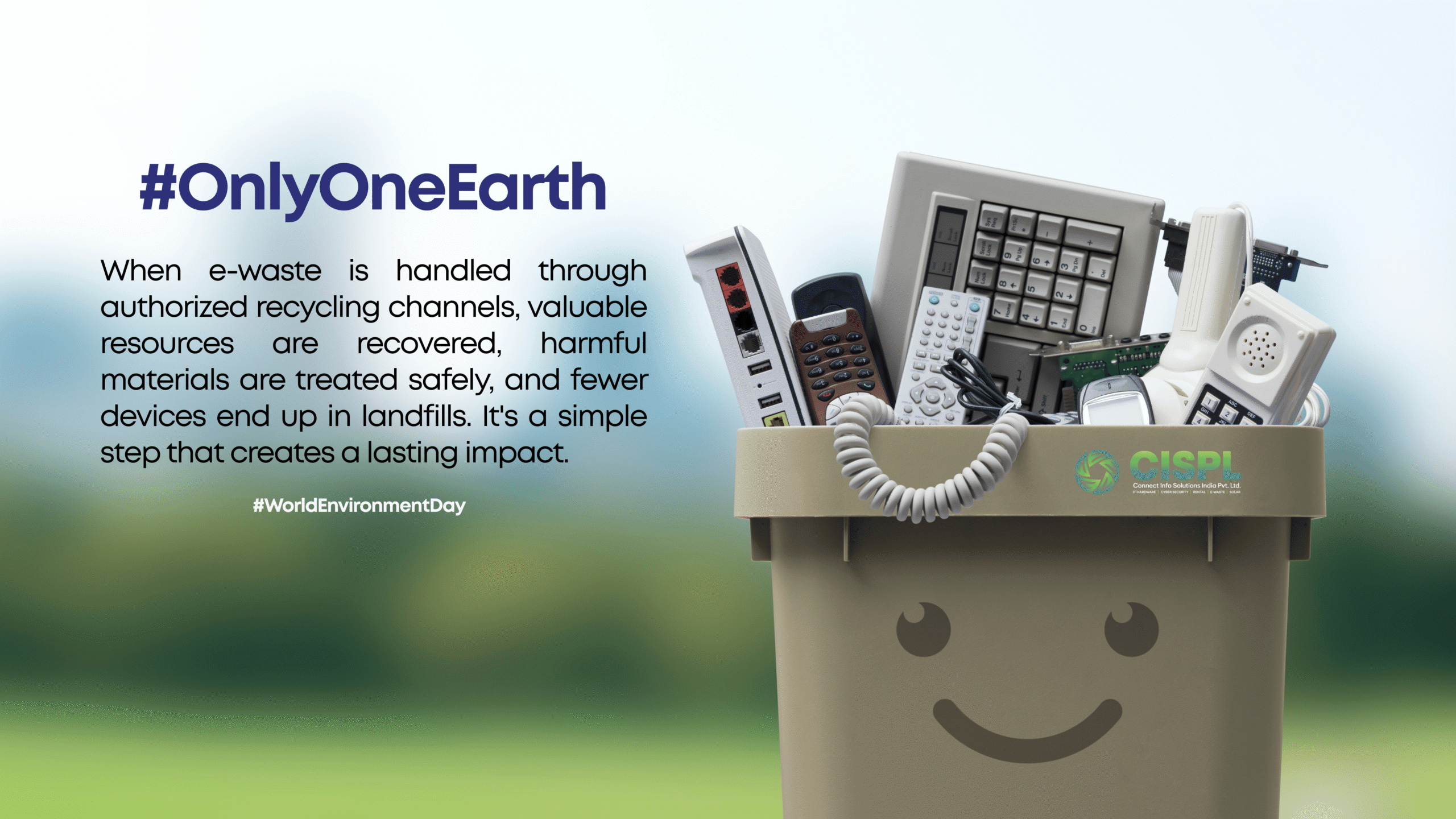
When e-waste is handled through authorized recycling channels, valuable resources are recovered, harmful materials are treated safely, and fewer devices end up in landfills. It’s a simple step that creates a lasting impact.

Sustainability Starts with Businesses

Today’s organizations are increasingly focusing on sustainability—not just because regulations require it, but because customers, employees, and stakeholders expect responsible business practices. Every laptop recycled responsibly, every server decommissioned securely, and every obsolete IT asset processed through authorized channels contributes to a cleaner future.

Responsible e-waste management also protects sensitive business data, supports environmental compliance, and promotes the circular economy by giving materials a second life. It’s a win for businesses and for the planet.

How CISIPL Makes a Difference

At CISIPL, we help organizations dispose of their IT assets responsibly without compromising security or compliance.

Our e-waste solutions include:

  • Collection of laptops, desktops, servers, mobile phones, batteries, PCBs, and other electronic equipment.
  • Secure data destruction before devices are dismantled.
  • Environmentally responsible recycling through authorized processes.
  • Reverse logistics to simplify asset collection from multiple locations.
  • Compliance with applicable e-waste management regulations.

Our goal is to help businesses reduce environmental impact while ensuring every device is handled responsibly from collection to recycling.

Small Choices Create Big Change

It’s easy to think environmental change happens through massive global initiatives. In reality, it often starts with simple decisions. Choosing an authorized recycler instead of an informal scrap dealer.

Recycling an old laptop instead of storing it away. Partnering with organizations that value sustainability. These small actions, repeated across thousands of businesses and millions of individuals, make a meaningful difference.

This World Environment Day, Let’s Choose Better

The message behind World Environment Day is simple: protect the one planet we all share.

Responsible e-waste disposal may seem like a small step, but it’s one that helps reduce pollution, conserve resources, and build a more sustainable future. At CISIPL, we’re proud to support businesses on that journey by providing secure, compliant, and environmentally responsible IT life cycle and e-waste solutions.

Because every responsible choice today creates a better tomorrow.

This World Environment Day, let’s do our part—for our businesses, our communities, and our only Earth.

touch with CISIPL →

Why E-Waste Awareness in India Belongs in Education System

Introduction

Global e-waste volumes are projected to hit 74 million metric tonnes by 2030, and India’s own generation is climbing at roughly 20% a year. Despite growing government and industry action, a persistent knowledge gap remains one of the biggest obstacles to proper disposal — which is exactly why E-waste awareness in India deserves a place in school and college curricula, not just corporate policy.

Why E-waste Awareness in India Matters

Electronic devices contain lead, mercury, cadmium, and brominated flame retardants. When dumped instead of recycled, these substances leach into soil and water — degrading ecosystems and, over time, threatening human health. Communities near informal e-waste processing sites face disproportionate exposure, with documented impacts on respiratory health, neurological development in children, and long-term soil quality.

The scale of the problem makes individual action feel insignificant. But individual choices, multiplied across hundreds of millions of technology users, are precisely how the problem grew this large — and how it gets better.

Five reasons nations are investing in e-waste management:

    1. Reduces demand for raw materials — recovered metals cut mining and production costs, easing pressure on finite natural resources
    2. Cuts greenhouse gas emissions — most global e-waste is landfilled or incinerated, releasing harmful gases that accelerate climate change
    3. Protects the environment — proper handling keeps toxins out of soil and water, preserving ecosystems for future generations
    4. Protects wildlife and marine life — responsible recycling reduces ecosystem contamination from heavy metals and chemical compounds
    5. Improves data security — certified recyclers ensure sensitive personal and corporate information is destroyed, not exposed through informal channels

How Students Can Contribute to E-waste Awareness in India

Young people are among India’s heaviest technology consumers — and increasingly, its most environmentally conscious citizens. Students don’t need to wait for policy to act. Small, deliberate choices compound into significant impact.

    • Use certified e-waste recyclers instead of informal scrap dealers — look for PCB-authorised collectors in your city
    • Donate working devices to NGOs, schools, or community programmes that extend product life and bridge the digital divide
    • Sell functioning old electronics through legitimate resale channels rather than discarding them prematurely
    • Engage with brand take-back programmes run by Samsung, HP, Dell, and others — most are free and widely available
    • Start a campus e-waste drive — a single initiative can divert hundreds of devices from landfill in one day

Building the Habit Early

E-waste awareness in India campaigns and classroom initiatives can shift responsible disposal from an afterthought to an ingrained habit — the same way recycling paper and plastic became second nature to earlier generations. When environmental responsibility is taught early and reinforced consistently, it stops being a corporate obligation and becomes a personal one.

Schools and universities that integrate e-waste education into science, technology, and sustainability programmes aren’t just producing more responsible graduates. They are producing future procurement managers, IT heads, and business leaders who will make better decisions about technology acquisition, use, and disposal at scale.

Organisations like CISIPL are working to extend that awareness beyond the classroom into corporate India — helping businesses build the same responsible habits through certified e-waste collection, secure data destruction, and compliant IT asset disposal programmes.

Want to bring a certified e-waste program to your organization or campus?

Connect with CISIPL →